Jaipur changes colour twice in the autumn. First for Navratri, when the city turns orange and red, and again for Diwali, when it turns gold. Both are flower festivals as much as they are anything else, and for the better part of two months the flower market is the busiest place in the city.
This is a guide to what to buy, when to buy it, and how to keep it alive through a fortnight of open doors and burning diyas.
The dates this year
Sharad Navratri begins with Ghatasthapana on Sunday, 11 October 2026 and runs to Monday, 19 October. Dussehra falls on Tuesday, 20 October.
Karva Chauth is on Thursday, 29 October.
The Diwali days run from Friday, 6 November to Tuesday, 10 November. Dhanteras on the 6th, Chhoti Diwali on the 7th, Lakshmi Puja on Sunday the 8th, Govardhan Puja on the 9th and Bhai Dooj on the 10th.
Two things follow from that calendar. The festive season is a month long, not a weekend. And the flower market is under pressure for most of it.
Why flowers, and not another box of sweets
Most houses end the season with more mithai and more dry fruit than anyone can eat, and a fair amount of it moves from one house to the next without being opened.
Flowers are the one festive gift that does not get passed along. They are used the day they arrive. They suit a household you do not know well. They raise no question about diet or diabetes or whether the seal is intact. For anyone sending to a client, a landlord, a doctor or a neighbour, that is the whole argument.
The festive palette
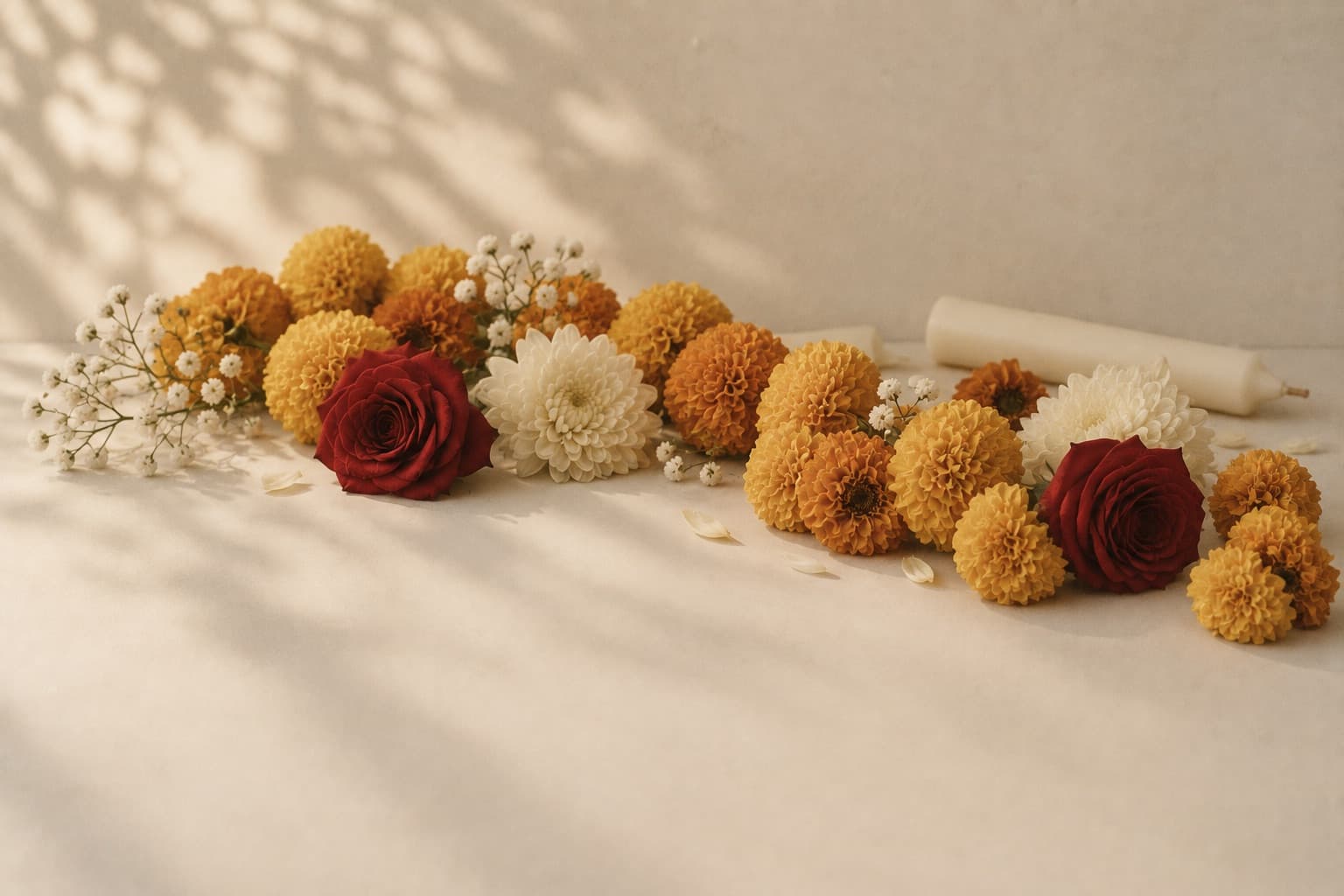
Warm colours carry the season. Marigold gold, deep orange, red, and the amber end of the chrysanthemum range.
Left to itself that palette turns heavy, and gold starts to read as brown. It needs one cool thing in it. White gypsophila, an ivory chrysanthemum or a white gerbera lifts the whole arrangement and makes the gold look like gold again. A single deep red rose set into an all-gold arrangement does the same job from the other direction.
Lilac is the unexpected one. A few lilac carnations among marigold stop an arrangement looking like every other arrangement on the street, and the two colours are better neighbours than they sound.
Navratri, a colour a day
Many houses in Jaipur follow the nine colours through the nine days. In 2026 the sequence runs orange, white, red, royal blue, yellow, green, grey and purple, ending with peacock green on 19 October.
Flowers can follow some of that and not all of it.
Orange, white, red, yellow and purple are straightforward. Marigold, white chrysanthemum, red rose, yellow gerbera, purple statice.
Royal blue, grey and peacock green are not flower colours. Anything offered to you in those shades has been dyed, usually a white chrysanthemum stood in coloured water overnight. If you want those three days matched, match them with cloth, with rangoli or with the diyas. We will not dye a flower blue and sell it to you as a variety.
For the days that do work, a small arrangement changed each morning is a lovely thing to keep beside the kalash. It becomes a nine-day ritual rather than a purchase.
Flowers for the puja space
Tradition is fairly settled here. Marigold and tuberose for the daily puja through Navratri. Lotus for Lakshmi Puja on Diwali night, where you can find it — the weeks after the monsoon are its season in Rajasthan, and it is worth asking your regular flower seller a week ahead rather than on the day.
Keep puja flowers separate from decorative ones. Anything offered at the shrine should be fresh that morning and unbruised, and that is far easier to manage when it is not part of a larger arrangement you are also trying to make last.
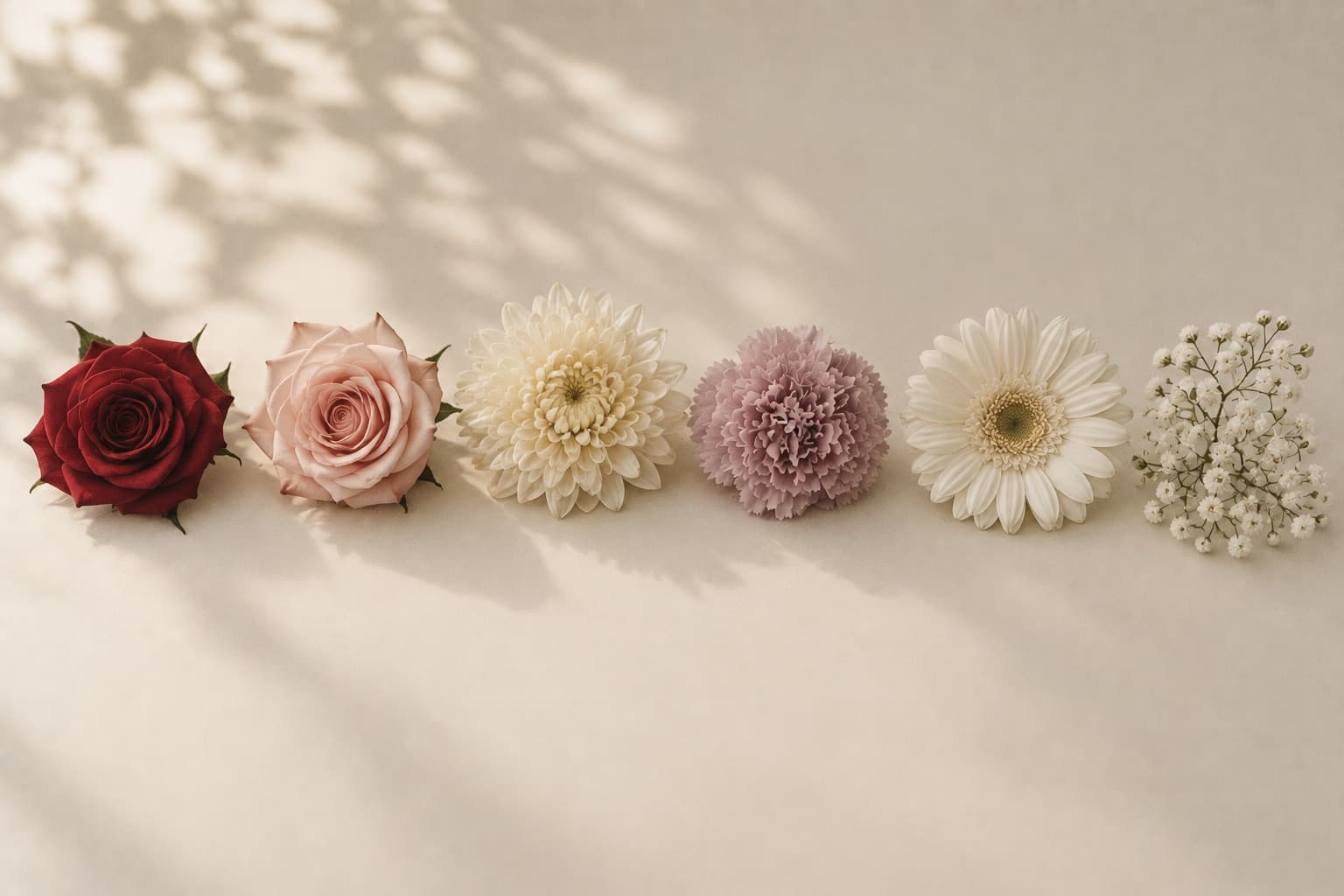
Our boxes are not puja flowers. They are built from roses, chrysanthemum, carnation, gerbera, gypsophila and solidago, and they are meant for the table, the entrance and for giving away.
Decorating the house
A toran of marigold and mango leaves over the main door is the oldest part of all this and still the best of it. Buy the marigold by weight on the morning you need it, not the day before.
An urli, or any wide brass plate of water, with marigold heads and a few floating diyas does more for an entrance than any amount of string lighting. Change the water every morning. Heads left sitting in still water for two days will start to smell.
Rangoli made with petals rather than powder lasts a day and photographs beautifully, which makes it worth the trouble on Diwali itself. Marigold heads pull apart easily into petals. Rose petals hold up better if the rangoli is somewhere people will be walking around it all evening.
On the dining table, keep the arrangement low. A tall one means guests talking to each other through a hedge. A long shallow box down the centre of the table is the right shape for a festive dinner.
Keep every flower a hand's width from a flame. Dry marigold catches easily, and a paper box beside a diya is not a risk worth taking.
Jaipur weather, and what it does to your timing
October in Jaipur is still warm. Daytime temperatures in the low thirties are normal through the first half of the month, and the nights only really start to cool as Diwali approaches.
That means flowers bought on the morning of the 11th will not necessarily look their best on the evening of the 12th. Buy in the morning, keep arrangements out of the afternoon sun, and top up the water every single day rather than every second day.
By Diwali the weather is on your side. Early November nights in Jaipur are cool enough that the same flowers last noticeably longer than they did three weeks earlier.
Buying, and buying early
In the week before Diwali the wholesale market moves fast and prices move with it. Marigold rises sharply over the last two or three days, and the best stems of everything else are gone by seven in the morning.
If you are ordering a box, order a day or two ahead of the date you need it, and choose your delivery slot at checkout rather than leaving it to the last morning.
Our two delivery windows are the same through the festival as they are in any ordinary week. An order placed between 6:00 AM and 2:00 PM is delivered by 6:00 PM the same day. An order placed between 2:00 PM and 6:00 AM is delivered by 12:00 noon the next day. Delivery is free across thirty Jaipur pincodes, 302001 to 302039.
We do not offer anything faster than that. During Diwali week in particular, we would rather say so plainly than promise a three-hour delivery we could not keep.
Making it last the whole season
Change the water daily rather than every second day. A warm room full of people is hard on flowers.
Move arrangements back from the door in the evening, when it is standing open and the dust is coming in with everyone else.
Take out any bloom that has gone over. One dying flower ages the rest of the box.
If the stems sit in floral foam, pour a little water in at the edge each morning until the foam is damp all the way through.
What to send, and to whom
For parents and elders, something that stays behind. A lidded box works better than a bunch, because it sits on the sideboard long after the flowers have gone.
For a client or a colleague, peach and gold, and no red. Red reads as personal.
For Karva Chauth on 29 October, red and deep pink, sent in the morning rather than the evening.
For Bhai Dooj on 10 November, yellow and white are the traditional reading, and a smaller box travels better if it is going to be carried between houses.
For a neighbour, anything warm. The point is mostly that it arrived.
Whatever you choose, order it early. That is the whole of the advice. The rest is only colour.